

California Sales Tax Audit Notices and Terms
 Author
John Milikowsky, Esq. | Founder | John Milikowsky represents U.S. and foreign businesses and individuals in sophisticated business transactions involving U.S. tax matters. Relentlessly defending each client in federal and state audits and criminal investigations to protect their civil rights and provide financial security.
Quick Summary:
California sales tax audits run on a sequence of documents, and each one opens and closes a window to respond. Knowing which document is in your hand tells you where the audit stands, what the auditor is asking for, and how much room is left to change the outcome. This guide covers the terms business owners actually see, in the order they tend to see them, and what to do at each point. This article walks business owners through the terms used in California CDTFA Sales Tax Audit notifications and determinations to help them better navigate the audit process.
What Order Do California Sales Tax Audit Notices Arrive In?
Most sales tax audits produce the same sequence of documents. The Notice of Determination and its 30-day petition deadline are the turning point: everything before it is the auditor’s recommendation, and everything after it depends on whether a petition was filed in time.
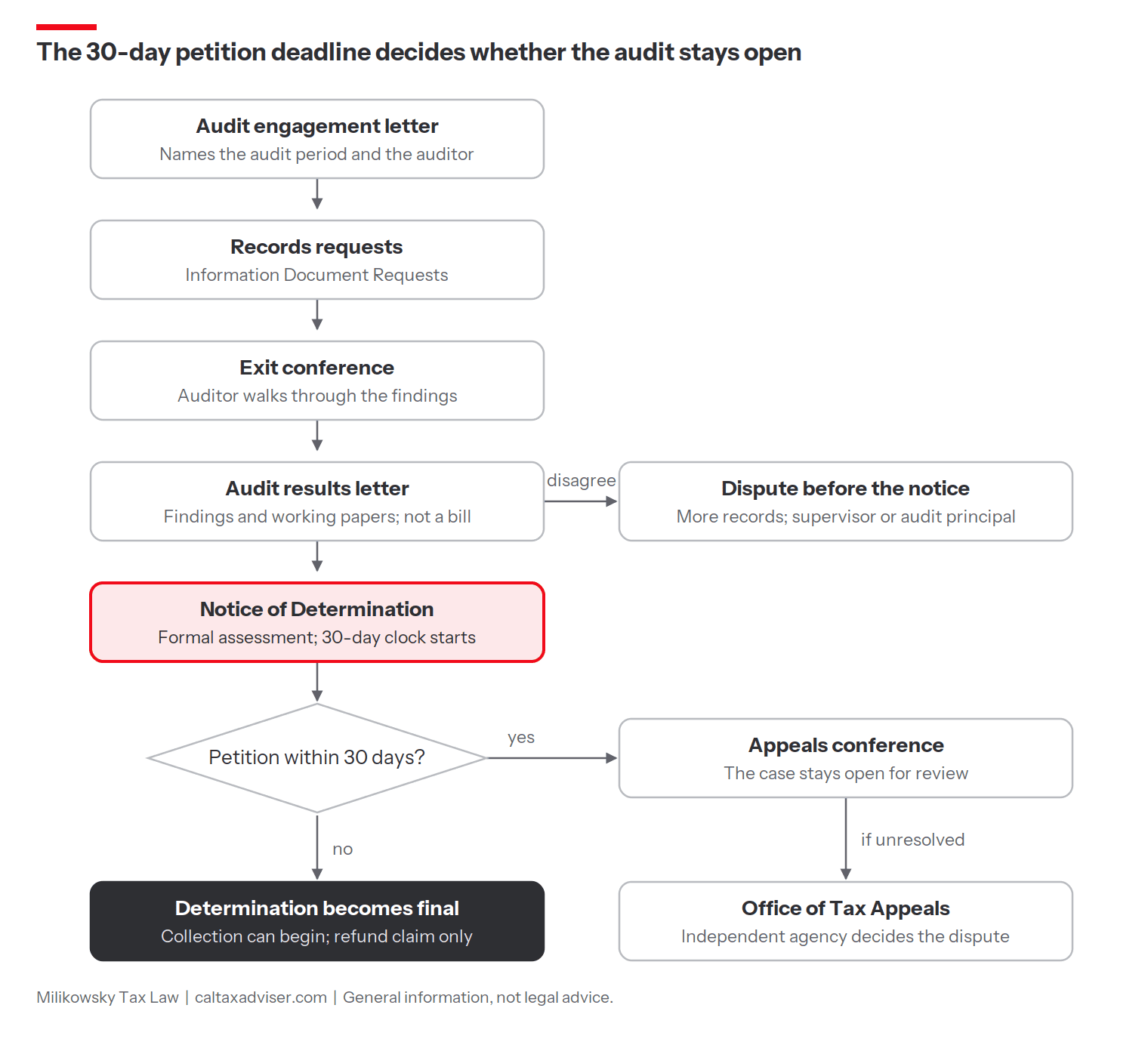
Disputes raised at the audit results stage can change the numbers before any assessment is issued; a missed petition deadline makes the assessment final.
What Is a Report of Field Audit?
The Report of Field Audit is the auditor’s written summary of what the audit found and what changes are recommended. Business owners and their CPAs still use that name, and older audits carried a form by that title. In CDTFA’s current system, the same findings arrive as a Preliminary Audit Results Letter, sent with the audit working papers, followed by a Final Audit Results Letter once a supervisor or reviewer has signed off.
Neither letter is a bill. CDTFA’s own Audit Manual states that the Final Audit Results Letter is not a Notice of Determination, and that the formal assessment is issued separately. That gap between the findings and the assessment is the most valuable time in the entire audit.
The audit working papers are the schedules behind the numbers. They show which records the auditor used, which periods were tested, how errors were calculated, and how a test result was projected across the audit period. Ask for them if you did not receive them, and read them line by line. Most disputes are won or lost on what those schedules assume.
When a client brings me audit results, we skip the totals and go straight to the working papers. The totals tell you what the auditor concluded. The schedules tell you whether the conclusion holds up, and in many audits the projection rests on a short test period or a markup assumption that does not fit how the business actually operates.
What does “tax measure disclosed by examination” mean?
It means the dollar amount of sales or purchases the audit found should have been taxed but was not reported. The “measure” is the base the tax rate is applied to. It is not the tax you owe.
That distinction matters when owners first see the number. If the schedule shows $100,000 in tax measure disclosed by examination, and the applicable rate is 8%, the additional tax is $8,000, before interest and any penalties. A business owner who reads the $100,000 as the bill can panic over the wrong figure. A business owner who reads $8,000 as the whole story can underestimate the interest that has been running since the original return was due.
The same idea shows up under several labels on audit paperwork, including audited taxable measure, additional taxable measure, and difference in taxable measure. Each one describes the base amount, and each one should be traced back to the schedule that produced it.
The tax measure disclosed by examination is where we start asking questions. Where did the number come from? Was it a bank deposit analysis that counted transfers and loans as sales? Was it a markup percentage borrowed from an industry average instead of the business’s own records? Was one slow or busy month projected across three years? Each of those is a reasonable question to put to the auditor, and the answers often move the number.
What Do the Terms on My Sales Tax Audit Schedules Mean?
Audit schedules group the findings by type. A handful of terms account for most of the dollars in most audits, and each one points to a specific kind of record that can confirm or challenge it.
| Term on the schedule | What it means | What to check |
|---|---|---|
| Unreported taxable sales | Sales the auditor believes were made but not reported on your returns | The source of the estimate: bank deposits, credit card data, POS reports, or a markup test |
| Disallowed sales for resale | Sales you reported as nontaxable resales, rejected because support is missing | Resale certificates dated before or at the time of sale, and customer verification responses |
| Disallowed exempt sales | Exemptions claimed on the return that the auditor found unsupported | Exemption certificates, shipping records for out-of-state sales, contracts |
| Ex-tax purchases subject to use tax | Items your business bought without paying tax and used itself | Whether tax was actually paid to the vendor, and whether the item was resold |
| Percentage of error | An error rate found in a test period or sample | Whether the test period was typical of the business, and whether unusual one-time items were removed before projecting |
| Markup analysis | A comparison of your sales to your cost of goods to estimate what sales should have been | Whether the markup reflects your actual pricing, waste, spoilage, theft, and promotions, or an industry average |
| Bank deposit analysis | Total deposits compared to reported sales | Whether loans, owner contributions, transfers between accounts, and refunds were removed |
Two of these deserve extra attention because they can multiply a small error into a large assessment. The percentage of error is a projection. An auditor who finds a 4% error rate in one quarter may apply that rate to every quarter in a three-year audit. If the test quarter included a one-time event, such as a catering contract, a remodel, or a bookkeeping change, the projection carries that anomaly across every period.
The markup analysis is an estimate built on assumptions about your business. Restaurants, liquor stores, and convenience stores see this method often. A markup that ignores spoilage, comped meals, employee meals, or a pricing change partway through the audit period will overstate sales, sometimes by a wide margin. One issue that comes up frequently is an auditor relying on a shelf-price test from a single visit, when the business’s prices or product mix changed during the period under review.
I Got a Notice of Determination. What Do I Do?
A Notice of Determination is CDTFA’s formal assessment. It states the additional tax, interest, and any penalties the agency has determined you owe, and it starts a 30-day deadline to file a petition for redetermination.
That deadline is the single most important date in a California sales tax audit. If no petition is filed in time, the determination becomes final. At that point CDTFA can move to collection, and the business generally loses the right to contest the assessment through the petition process. What remains is paying the tax and filing a claim for refund, which is a slower and harder road.
A few points about the notice itself:
- Read the date on the notice. The 30 days generally run from the date on the notice. Opening the envelope late does not extend them. A notice that sat in a closed business’s mailbox for two weeks has two fewer weeks of response time.
- Check who it names. Determinations can be issued to the business and, in some cases, to individual owners or officers. A notice addressed to you personally is a different problem from a notice addressed to the company.
- Look for the word “jeopardy.” A Notice of Jeopardy Determination has a much shorter response window and can be collected immediately. Treat it as an emergency.
A petition does not have to be a finished legal brief to preserve your rights. It must be timely and in writing, and it should identify the issues in dispute. Detailed arguments and evidence can follow.
By the time a Notice of Determination arrives, a lot of the easiest opportunities to change the numbers have already passed. The exit conference and the audit results letter are where you have the most room. That said, I see business owners every year who assume the notice is the end of the road. It is the start of the formal dispute process, and a timely petition keeps every option open.
What happens before the Notice of Determination?
Before CDTFA issues the notice, the auditor holds an exit conference to walk through the findings, and the business receives the audit results and working papers. If you disagree, you can provide additional records and request a discussion of the disputed items with the audit supervisor or the district’s audit principal. Issues resolved at this stage never reach the assessment, which is why the weeks before the notice deserve as much attention as the 30 days after it.
Other Sales Tax Audit Terms Business Owners Should Know
Waiver of limitations (CDTFA-122)
During a long audit, the auditor may ask you to sign a waiver of limitations. CDTFA generally has three years from a return’s filing to assess additional tax, and the waiver extends that window for specific periods so the audit can finish without the oldest quarters expiring.
Signing is voluntary, and the decision has trade-offs. Refusing can prompt CDTFA to issue an assessment on the expiring periods quickly, often on less complete information. Signing keeps those periods open longer, along with the interest running on them. This is a decision to make with your representative, with the specific periods in front of you.
Petition for redetermination and appeals
A petition for redetermination is the written request that keeps a Notice of Determination from becoming final. After it is filed, the case is reviewed again. Disputes that remain unresolved can go to a conference with CDTFA’s appeals staff, and from there to the Office of Tax Appeals, an independent agency that decides California tax disputes.
Negligence and fraud penalties
A negligence penalty adds 10% of the tax deficiency when CDTFA concludes the underreporting resulted from carelessness or disregard of the rules. Inadequate records are a common basis. A fraud penalty adds 25% and also extends how far back CDTFA can assess. Both penalties are worth contesting on their own, even when some tax is owed. A penalty requires its own justification, and auditors’ penalty recommendations do not always survive review.
Responsible person liability
When a corporation or LLC closes or stops operating with unpaid sales tax, California law allows CDTFA to hold certain individuals personally liable for that tax. The rule applies to people who were responsible for the business’s sales tax compliance and who willfully failed to pay, and ownership alone is not enough. A determination issued to an individual is sometimes called a dual determination. Owners who are winding down or selling a business with an open audit should understand this exposure before the business closes.
Claim for refund
A claim for refund is a written request to recover tax that was overpaid. Audits can turn up overpayments too, such as tax paid on purchases that were later resold. A claim is also the route back if a determination became final and was paid, though it is a harder path than a timely petition.
When Should a Business Owner Get Help With a Sales Tax Audit?
The paperwork in a California sales tax audit is built for auditors, and the timing works in the agency’s favor. By the time a business owner understands what a schedule says, the window to respond to it may be half gone.
A common mistake business owners make is waiting for the Notice of Determination before getting help, on the theory that nothing is official until then. The audit results letter is often the better moment. The working papers are fresh, the auditor can still revise the schedules, and every correction made before the notice is one that never has to be argued on appeal.
Business owners who receive audit results, a Notice of Determination, or a request to sign a waiver can contact Milikowsky Tax Law to review the paperwork and the deadlines that come with it.
Frequently Asked Questions
What does tax measure disclosed by examination mean?
It is the additional amount of sales or purchases the audit found should have been taxed. It is the base the tax rate is applied to, so the tax owed is a percentage of that figure, plus interest and any penalties.
Is an audit results letter the same as a Notice of Determination?
No. The audit results letter presents the auditor’s findings and recommendations. The Notice of Determination is the formal assessment, issued separately, and it starts the 30-day deadline to file a petition for redetermination.
How long do I have to respond to a Notice of Determination?
Generally 30 days to file a petition for redetermination. A Notice of Jeopardy Determination has a much shorter deadline. If no petition is filed in time, the determination becomes final.
Can I still disagree with the audit after the exit conference?
Yes. You can provide additional records and request a discussion of disputed items before the Notice of Determination is issued, and you can file a petition for redetermination after it is issued.
What is unreported taxable sales on a sales tax audit?
It is the auditor’s estimate of taxable sales that were made but not reported. The estimate usually comes from bank deposits, credit card data, point-of-sale records, or a markup analysis, and each method rests on assumptions that can be reviewed.
Do I have to sign a waiver of limitations?
No. Signing is voluntary, but refusing can lead CDTFA to assess the expiring periods quickly. The right choice depends on the specific periods and the state of the audit.
Can I be personally liable for my company’s sales tax?
Possibly. California law allows CDTFA to hold responsible individuals personally liable for unpaid sales tax of a corporation or LLC that has closed or stopped operating, when they willfully failed to pay. Ownership alone does not create that liability.
Sources
- CDTFA Audit Manual, Chapter 2, Preparing and Completing Audits
- CDTFA Audit Manual, Chapter 14, Appeals Procedures
- CDTFA Audit Manual, Chapter 7, Reaudits
- CDTFA Guidelines and Manuals index

